Showing posts with label IFA. Show all posts

Wednesday, April 1, 2026

1950 English Report on the Leipzig Trade Fair (DDR)


Photos from the 1949 and 1950 Leipzig Messe

1950 saw the true introduction of the IFA F9

BMW / EMW

IFA F9s and some BMW 321s

IFA F8 Export Luxus and Kombiwagens

IFA F9s

The IFA F9 convertible

IFA F9

IFA F9

IFA F9

IFA F8 Convertibles

IFA range

IFA F8s

This is a later photo featuring the unique IFA F9 convertible

IFA F8 Kombiwagen among the Framo and Phaenomen section

IFA display

BMW / EMW section including the new BMW 340-1, 321 roadster, 340 ambulance and a prototype example of the planned successor to the 340-1 (in centre with unusual grill)

The Soviet display

The Soviet display featuring a Zil limousine 

Wednesday, January 4, 2017

Temporary Trabant Museum Collection, Zwickau 2017


The Trabant was built at the old Audi factory in Zwickau for more than 30 years. The factory is now the August Horch Museum and the museum normally has a large exhibition dedicated to the factory's post-war history. The collection includes a rare post-war Horch 930S and an extensive display of IFA vehicles and Trabants. Unfortunately for us, when we visited the museum in July 2017, the post-war section was closed for renovation. Part of the post-war museum collection had been moved to the nearby Trabant International Register museum, so we took the opportunity to visit the little collection and it was a very pleasant local museum staffed by enthusiastic volunteers. Today, the collection is back at the August Horch Museum in a greatly expanded wing. https://www.horch-museum.de/

The Trabant's predecessors - IFA F8 and F9, which were copies of DKW prewar cars. https://dkwautounionproject.blogspot.com/2017/07/trabant-east-german-peoples-car.html

The IFA F8 was the postwar copy of the prewar DKW F8, with some minor modifications. https://dkwautounionproject.blogspot.com/2020/11/ifa-f8.html

The IFA F9 was the realization of the 1939 DKW F9 'Hohnklasse.' DKW only built 9 pre-production examples before the war intervened. IFA managed to recovered a single surviving example in Leipzig and used it to reverse engineer their version of the car. That they were able to revive the car and get back into production by 1949 was a miracle. https://dkwautounionproject.blogspot.com/2020/07/the-development-of-ifa-f9.html
The Horch P240. During the war Horch had ceased manufacturing luxury cars and become a heavy truck manufacturer. After the war they continued building trucks but they did have a few Horch 930 chassis tucked away and they were used to build half a dozen limousines for party officials. These cars were so prized that Horch was contracted to build a production car. The result was the P240. It was a far cry from the extravagant luxury of their prewar cars but these were austere times. Only a few hundred were built. http://heinkelscooter.blogspot.com.au/2011/02/veb-sachsenring-east-germanys-peoples.html

The Horch P240 had some stylistic influences of heavy American cars of the 1950s. https://dkwautounionproject.blogspot.com/2023/04/1955-sachsenring-p240-review-der.html

IFA F9 cabriolet https://dkwautounionproject.blogspot.com/2023/12/1949-ifa-dkw-f9-brochure.html

The Trabant's predecessor - the AWZ P70. The similarity to the Trabant lies in its use of Duraplast bodywork, but under the this new skin the car was basically an IFA F8. https://dkwautounionproject.blogspot.com/2022/12/1955-awz-p70-f8-in-new-guise.html

Raw Duraplast panel with the cotton tailings still attached. Despite ridiculous modern claims that the Trabant is made of cardboard or other such rubbish, Duraplast is an amazing product that creatively uses two waste products - cotton waste and a phenolic resin byproduct of the chemical dying industry - to produce something entirely new and useful. Duraplast is somewhat similar to carbon fibre these days. https://dkwautounionproject.blogspot.com/2022/05/auto-union-and-development-of-duroplast.html

The golden age of the East German workers paradise was the 1970s. At this point East Germany could feel it had almost reached the same level of prosperity as its western counterpart, but things would soon begin to slide. From the 1980s East Germany was in terminal decline and no amount of propaganda could disguise it.

Trabi folding rooftop tent. An amazing option available for East German camping enthusiasts.

Trabant P60 https://dkwautounionproject.blogspot.com/2021/01/1960-veb-sachsenring-p50-trabant.html

A diorama of the famous Trabi breaking through the Berlin Wall.

I think the first Trabants are the best looking. They are handsome budget cars for the period, much like their western contemporaries, such as the Goggomobil or NSU Prinz. https://dkwautounionproject.blogspot.com/2017/07/trabant-east-german-peoples-car.html
Trabant P50. Early models sometime featured two-tone paintwork and chrome trim.

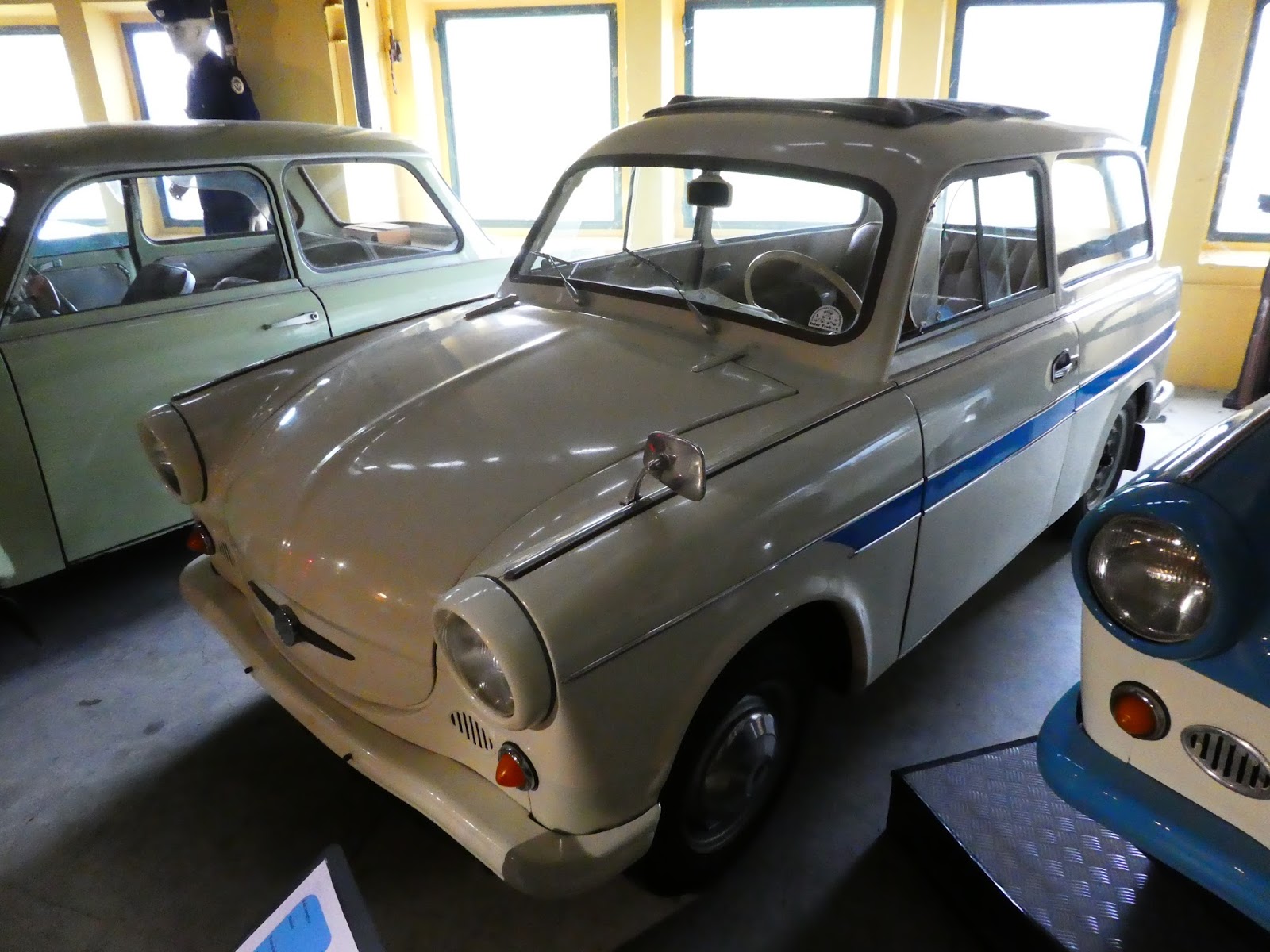
Trabant P60 kombi. The new P60 model toned down the paint and trim a little.

The classic Trabant - the Trabant 601 https://dkwautounionproject.blogspot.com/2024/08/1987-trabant-601-owners-manual.html

Trabant 601

From newest to oldest. The Trabant 1.1 featuring a Volkswagen Polo engine.

Trabant kubel was the military version of the Trabant.


One of Trabant's many stillborn models. The designers at Sachsenring constantly attempted to replace the Trabant with a more modern design but as this would require retooling the factory, the management always refused to fund it.

IFA sign

Exploded Trabants

Flying Trabant

The place to see the Trabant and its history is once again the August Horch Museum in Zwickau. https://www.horch-museum.de/
In Berlin and other major cities in the former Eastern Bloc, you can get behind the wheel and drive your own Trabant. It's great fun: https://heinkelscooter.blogspot.com/2011/11/tabi-safari.html


Sunday, February 22, 2015

1950 IFA F9 Roadster prototype


The Fahrzeugmuseum in Chemnitz, the home town of Auto-Union, is currently hosting an exhibition of early IFA cars. Amongst the cars on display is one very rare and special car – the only IFA F9 two seater roadster ever built.

The Auto Union Group (Audi, DKW, Horch and Wanderer) found itself on the wrong side of the border after Germany was divided into East and West at the end of the Second World War. While a company was re-founded in the West at Ingolstadt, their factories in the East were nationalised by the communist government and renamed IFA. IFA inherited DKW's plans, tools and designs, and in 1949 they were able to put into production their version of DKW's 1939 F9.

This very early IFA brochure for the F9 features marketing photographs of the original DKW F9 taken in September 1939. IFA's F9 was so similar in outward appearance to the DKW original few would have noticed.


East Germany may have been communist, but the people at IFA still wanted to build nice cars, so IFA decided to spruce up the F9 sedan and offer a two-seat roadster version. A single coach-built prototype was built and exhibited at the Leipzig Motor Show in 1950. The car was sleek and handsome and clearly targeted the export market in the west.

The prototype roadster in its heyday. The car originally had a silver finish. This photo was most likely taken when it was privately owned.

However, at almost exactly the same time DKW in West Germany had just released their version of the F9, named the F89. DKW did not have access to the car's original three-cylinder 900cc engine so the DKW version had to make do with the older, two-cylinder 700cc engine. Included in the range was a lovely two-seater Karmann bodied roadster.

The DKW Luxus Zweisitzer, or luxury two-seater, was bodied by Karmann Karosserie, who would later gain fame with the Volkswagen Karmann Ghia. These exclusive, hand-built cars came in coupe and cabriolet form. They were only offered between 1950 and 1955 and are extremely rare and sought after these days.


From IFA's perspective the release of the DKW F89 was unwelcome news. The car was basically the same car as the IFA F9 but even though the IFA car had a better engine, DKW had an established service network in the west that IFA simply could compete with. At that time IFA was already producing a coach-built roadster in the IFA F8 Luxus and didn't have the capacity to produce a second model so IFA decided to drop the F9 roadster idea. No more were built and the single prototype was sold to IFA works driver, Harald Linke in 1951, who drove it as his family car until 1957. After he sold the car it disappeared from sight and was rumored to have been scrapped.

Harald Linke behind the wheel of the prototype at a race meet in Hohenstein-Ernstthal.

Jump forward sixty old years and DKW enthusiast named Peter Lott from Stendal heard a rumor that there was a two-seater F9 somewhere in Berlin. From that slender lead he began an extensive search that finally paid off when he tracked down the car, parked under a lean-to in a garden in Koepeinek, East Berlin. The car was badly rusted and as the car had been exposed to the weather for decades, the interior was completely rotted out. It had also been altered substantially over the years.

Lott assessed the car as probably beyond economical repair and passed the lead on to DKW enthusiast and historian, Frieder Bach, who purchased the car. In December 2014 the car was part of a special display at the Fahrzeugmuseum, dedicated the F9 'people's car.' The roadster was displayed 'as found' under a replica of the lean-to. When the exhibition closed in March, the car was returned to Bach for restoration. I would expect this would take quite a few years.

Harald Linke is reunited with the car in the museum exhibition.

The interior is completely gutted and the floor rotted out in places.

When completely restored it will look like this replica roadster.

Starting with baby steps. DKW body restorer, Winfried Kuhl, replicated the dashboard from molds and measurements taken from the original DKW F9 prototype. http://dkw-karosseriebau.de/

For more information about the display and the museum, visit their website - http://www.fahrzeugmuseum-chemnitz.de/ and http://www.chemnitzer-geschichtsverein.de/CGV/Veranstaltungen.htm and https://www.zwischengas.com/de/news/F9-Sonderausstellung-im-Fahrzeugmuseum-Chemnitz.html and http://www.rt-forum.de/t1094f35-Saechsisches-Fahrzeugmuseum-Chemnitz.html  and http://www.kulturgut-mobilitaet.de/forum/6-plauderecke/23346-vorstellung-der-forumsmitglieder-mit-ihren-autos?start=320