



1934 in Germany was the year that rear-engined streamlined cars truly hit the headlines. For several years prior, commencing from 1930, many engineers across Europe were striving to be the first to bring to the market a rear-engined budget car "for the people." These days this complex story has been dumbed down into a moronic argument over whether Ferdinand Porsche at KdF (later Volkswagen) stole the rear-engine concept from Hans Ledwinka at Tatra. It is an entirely fake dispute driven by modern conceit and ignorance.
The mid-1930s interest in rear-engines was a typically German response to the challenges of mass production. In the US, Ford and other car makers reduced the unit price of motor cars by mass production and automation, supported by finance on easy credit terms. In Europe, where worker wages were much lower, car makers had completely ignored the mass market, focusing exclusively on the well-to-do. Cars were built in small batches, in relatively small factories, by technically skilled artisans. Implementing a mass production would have required many companies to completely restructure their operations and build entirely new factories. The capital outlay alone would put them out of business. JS Rasmussen of DKW, Germany's leading motorcycle manufacturer, implemented a moving production line for motorcycle production, but the DKW auto plant in Chemnitz - despite some automation - remained disfunctional, with chassis built in a plant outside of the city, engines built in Zschopau, and bodies shipped by train from Spandau in Berlin, 260 kilometres away. And DKW was one of the most efficient plants in Germany in 1932!

And so, if mass production was not an option, then cost reduction must be achieved through engineering. Reducing the size of the vehicle was one option. This was attempted by both Opel and Ford with some degree of success, although there were many complaints from the engineering community that down-scaling engines, chassis and gearboxes compromised both handling and performance. Creative engineers looked at the challenge from an entirely different perspective - utilizing a compact drive train where the engine directly drove the wheels removed the need for a transmission and differential. The next question was placement - if the drive train was to mounted in the front, the driven axles would need to be steerable; if mounted in the rear, the axles would not need to be steered. Either placement required independently suspended half axles.

DKW pursued the first option with their Front series of budget cars in 1931. They proved to be a great success but front-wheel drive involved additional engineering complexity and was not widely adopted at the time. Tractor maker, Hanomag, adopted rear-engine placement with their Komissbrot PS2/15 in 1924. Although the car was extremely basic and had a solid rear axle, it handled surprisingly well despite only being powered by a 400cc single cylinder four-stroke motor. It was a pioneer of a new engineering movement across Germany, Austria and Czechoslovakia, with multiple engineers experimenting with the concept, which proved to be more challenging than first realized.

Daimler-Benz was one these pioneering companies. Under the brand name, Mercedes-Benz, the company specialized in conventional luxury cars and commercial vehicles. Daimler-Benz approached the budget market as most other established car makers, scaling down one of their larger models and stripping features. This resulted in their mid-range 170 sedan of 1931, which apart from introducing swing rear axles, was otherwise conventional. In parallel, a design team under Hans Nibel and Max Wagner, were working on a rear-engine small car. Nibel and Wagner bought with them experience from Daimler-Benz' mid-engine race car program of the late 1920s. Ferdinand Porsche, had worked on that project and he would take the lessons he learnt their to Auto-Union for their mid-engine race program in 1935.

The first fruits of this project were not promising, being described as having "all the charm of a coal box." This small car showcased radical and modern features, such as a central tube chassis and independent four-wheel suspension, but Daimler-Benz was not prepared to sully its image on this strange variant. Nibel and Wagen returned to the drawing board and completely revised the car.

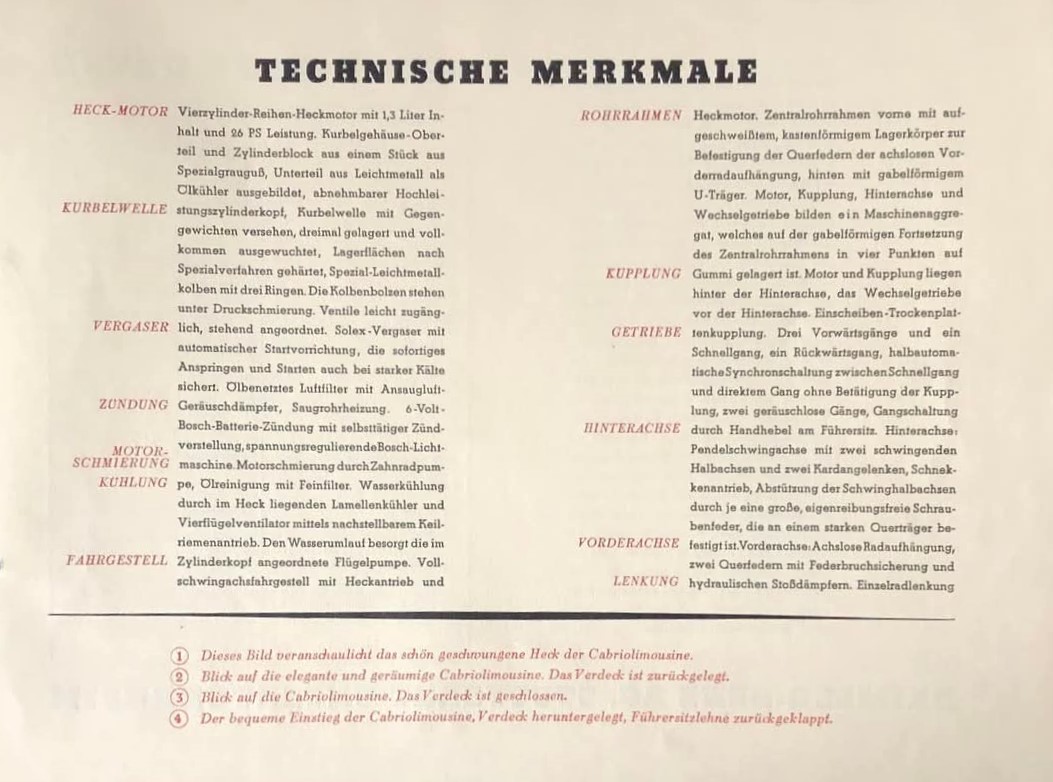
Gone was the box-like body in favor of radical streamlining. Several different bodies steel bodies were constructed for wind tunnel and road tests. The new car also received a newly designed 1.2 litre flat-four air-cooled engine, but this proved to be problematic in testing. Nevertheless, the new small car showed promise and plans were made to go into production. The flat-four engine however would need to be replaced. A conventional 1.3 litre water cooled engine generating 26 horsepower was substituted, but this immediately caused problems.

With a 35/65 front to rear weight differential, the use of the larger and heavier water cooled engine threw out the cars handling, causing serious over-steer in corners. Changes were made to the front and rear suspension, but motoring writers expressed concern. Both Ferdinand Porsche and rear-engine advocate, Josef Ganz, were consulted at various times to improve handling. Ultimately, handling was much improved in the second and third generations of the car, but the Mercedes-Benz 130 - the company's cheapest car - would not prove the success Daimler-Benz had expected.

In February 1936 the 130 was replaced by the completely redesigned Mercedes-Benz 170H. 4,298 130 cars had been built when the production ceased in April. While the 130 had never been designated "H" or Heckmotor, this additional identifier was required to differentiate the rear-engine 170 model from the popular front-engine 170 V model. The new car benefited from the lessons learned from the 130, with redesigned suspension, double acting shock absorbers on the rear, a larger, better engine and overall better fittings. Motoring journalists praised the new car, but over-steer remained a problem for the unwary driver. Given the car's higher price tag - and for just a little extra you could buy a conventional 170 V - sales proved to be slow. Only 1,507 cars were built before the model was withdrawn in October 1939.

For comparison, the 170 V model (below)

More links for this period:
Origin of the Volkswagen: https://heinkelscooter.blogspot.com/2012/03/volkswagen-world-beating-peoples-car.html
DKW Streamliner: https://dkwautounionproject.blogspot.com/2017/07/dkws-1933-rear-engine-streamliner.html
Standard Superior: https://heinkelscooter.blogspot.com/2015/07/standard-superior.html
Hansa 400: https://heinkelscooter.blogspot.com/2021/10/1934-hansa-400.html
Tatra Streamliners: https://tatrat600.blogspot.com/2020/09/tatras-streamliners-yesterdays-car-of.html
Tatra and the Self Licking Icecream: https://tatrat600.blogspot.com/2023/02/tatras-self-licking-icecream-cone.html
1936 Mercedes-Benz 170 H: https://heinkelscooter.blogspot.com/2025/02/1936-mercedes-benz-170-h.html
1935 Mercedes-Benz 150 H: https://heinkelscooter.blogspot.com/2025/02/1935-mercedes-benz-150-h.html
Mercedes Classics History: http://mercedesclasicos.com/19_mercedes_benz_130h-170h.html
1934 Motor Kritik review by Josef Ganz: https://motor-kritik.blogspot.com/2025/12/1935-motor-kritik-nr-1.html


