Friday, November 12, 2021

1921 Rumpler Tropfenwagen - Streamline Pioneer


Thursday, November 11, 2021

German Car Day 2021


Everybody in the classic motoring community has their own particular interests. I am interested in German vehicles - if you didn't know. Sadly for me, there is a notable shortage of interesting German vehicles from the periods I am interested in. There are a lot of more modern German vehicles in Australia. Perth's German Car Day is organised by the Mercedes-Benz Club of WA and is a very popular event for modern German vehicles. I had occasionally attended the German Car Day in the past but had not attended for several years, so I decided I would swing by the start of this year's show on Sunday 31 October 2021.

German Car Day starts with a display at the WACA carpark in East Perth and then followed in this instance with a drive to Gin Gin. Photo by Aslam Moosa.

Photo Aslam Moosa.

I drove my 1959 DKW F94. As soon as I arrived I noted I was somewhat out of place.

It should come as a surprise to no one that there would be a lot of Mercedes. There was a pretty good turn out of classics.

But I only saw two that interested me. This Mercedes-Benz 600 Grosser. Photo by Classic and Modern Show Cars https://www.facebook.com/profile.php?id=100063467711026.

And this 1960 Mercedes-Benz 300D limousine. Photo by Classic and Modern Show Cars.

This Opel is rare in Australia. Opels were never really sold her as GM products were covered by GM Holden. Photo by Aslam Moosa.

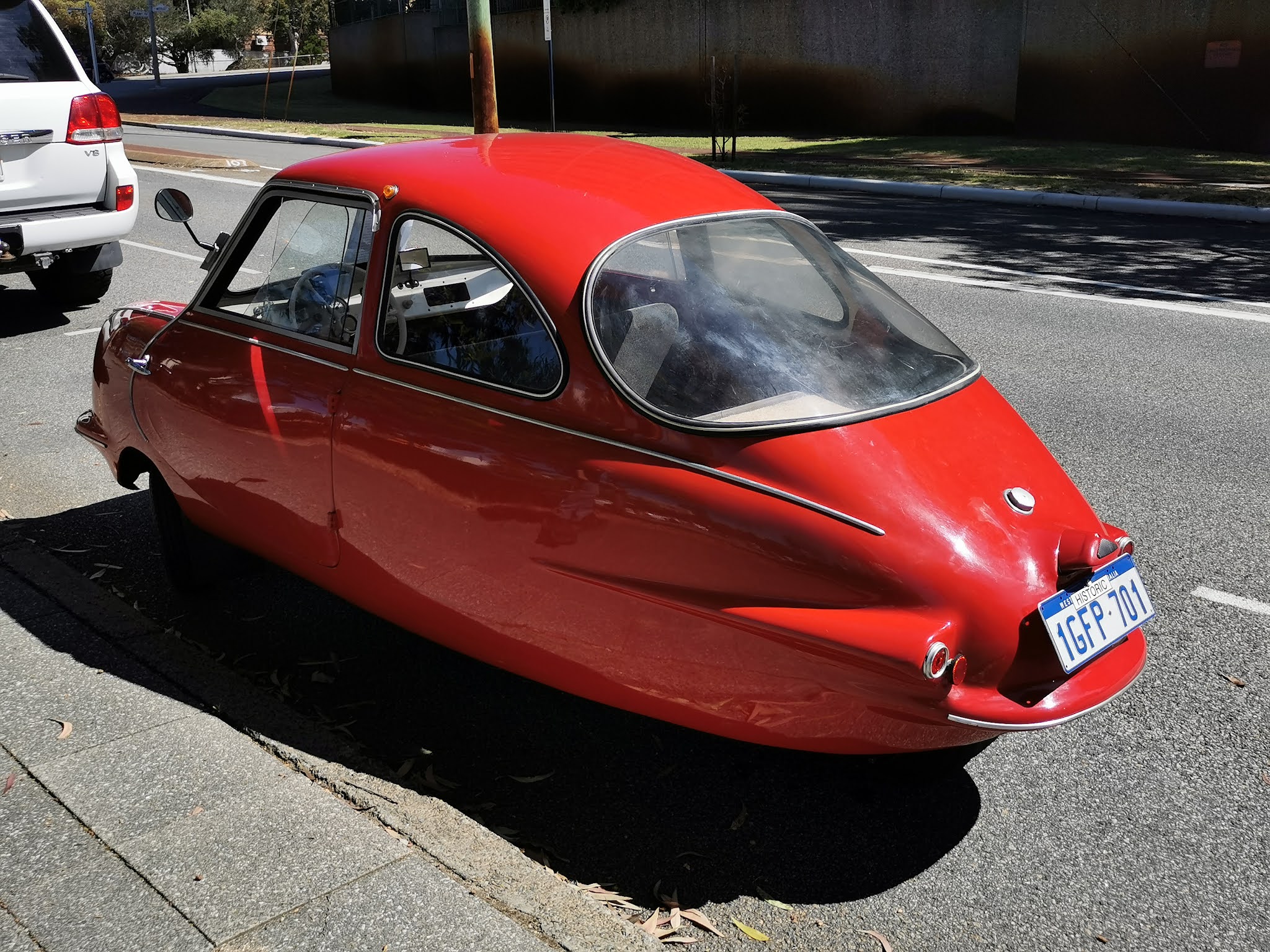
The only really interesting vehicle of the day was my friend Richard's Fuldamobil.

The Fuldamobil enjoys a reputation as being one of the worst motor cars ever made. There is so much wrong with the vehicle it's hard to know where to start.

But they do look quite space age.

Like my DKW, the Fuldamobil was completely out of place among the moderns. Perhaps it recognized the disdain with which it was regarded when it set off, trailing a huge cloud of two-stroke smoke behind it.

Hilarious!

German Car Day isn't really a classic event, but it certainly is successful for the modern enthusiasts who want to get out on the road and put their German engineering through its paces.

Thursday, November 4, 2021

TracMach and the Tractor Museum


On Saturday 30th October 2021 I drove the Tatra up to the Motor Museum at Whiteman Park. I am putting the Tatra on temporary display there for a couple of months. After dropping her off I wandered over to check out the Tractor Museum. I haven't visited there for many years. https://heinkelscooter.blogspot.com/2020/05/tractor-museum-whiteman-park.html

It takes a special kind of dedication to restore and preserve Australia's agricultural and industrial heritage. Tractors can't be driven on the road, you can't take them on a coffee run, they take up space and time and money. In Europe, tractors and farm heritage is a big thing. In Ireland and the UK there are more than twenty specialist magazines dedicated to vintage tractors. In Germany there are industrial fairs and 'tractor-treffen' which draw tens of thousands of attendees. But in Australia - nothing. My European friends find it hard to believe there is no interest in tractors. It's a very niche interest.

No less on my visit. I arrived at 12 and I was the first visitor of the day. Nevertheless, it was a pleasant visit as I had a good chat with the extremely helpful volunteers.

American McCormick-Deering

Caterpillar today still make tractors, mining and agricultural machinery. They were famous for the 'caterpillar' track.

Allis-Chalmers, another 1930s tracked tractor.

McCormick and Massey-Harris tractors from the 1950s in traditional red. Massey-Harris are now Massey-Ferguson.

1940s Fordson Major. Fordson were a subsidiary of Ford (obviously). Industrialization of farming in the US helped make that country the powerhouse that it became.

What I really came to see though was the museum's collection of Lanz Bulldog tractors from the 1930s.

Heinrich Lanz of Mannheim in Germany began manufacturing a simple and robust tractor in the 1920s. These became something of a tractor legend in Germany and in other places around the world where they were exported. Australia was a good market for the Bulldog and there are a large number here.

As I have mentioned, there is a wideranging enthusiasm for tractors and agricultural heritage in Germany and many a classic car enthusiast may also have a tractor in his back shed. A few years ago one of my DKW contacts reached out to me to ask if I knew of any Lanz Bulldogs in Australia. I said, I did, and this led to a long running search for documentation in Australia.

The Bulldog was powered by a single cylinder two-stroke diesel motor. This is the enormous piston - note the deflector top. The Bulldog would run on really low quality oil, in fact, almost any combustible liquid. Ignition was performed by a hot-bulb device that was heated up by a blow torch before starting the motor. Once the bulb ignition was red hot, the oil would ignite automatically on compression. This meant that the Bulldog did not require a battery, electrics, or spark plug.

Why were my German friends hunting for documentation about a German tractor in Australia? Apparently, Lanz did not provide a detailed workshop manual for the Bulldog. This was not unusual at the time as repair instructions were only issued occasionally to service offices. Lanz' Australian distributors were disatisfied with the lack of documentation and so customised and drafted their own guidance. It was definitely a long shot, but worth exploring.

The guys at the museum very kindly searched their library and found three manuals, which they leant to me for scanning. Extremely generous. https://heinkelscooter.blogspot.com/2021/10/lanz-bulldog-hr-5-operating-manual.html

Of course, it isn't just tractors. There are commercial vehicles on display. This is a Graham truck of 1924.

Two post-war Chamberlains. These are road driveable vehicles.

1939 Minneapolis Moline Standard Model

A hopper truck

Rotary plows

Sunshine Harvester farm machinery was a US company, but they had an assembly plant in Fremantle, Western Australia. The building today is a very cool food hall.

1950s row

Steam traction engine

The Tractor Museum doesn't have patrons with deep pockets like the nearby Motor Museum, but it does deserve your support. The preservation of our agricultural heritage and it is interesting if you spare the time. The Tractor Museum is only a few metres away from the Motor Museum. It's only $5 and children are free. Why not walk over and have a look. If you're in a motoring club and you're looking for somewhere to go - check it out. It's only through community support that the museum will survive for future generations. 

Visit their Facebook page here: www.facebook.com./TMofWA

Wednesday, November 3, 2021

The unkillable Lanz Bulldog


Germany has a well deserved reputation for the the manufacture of high-quality engineering and automobiles, and yet, until the late 1950s, German agriculture sector was notable for its backwardness and lack of industrialization. During the Great War, the British naval blockade of German fertilizer imports caused widespread famine in 1915 and 16. The problem for Germany was not one of space - Germany was almost twice it's current size at the time - but the diversion of manpower to the front during the farming seasons. German farmers were still plowing fields with oxen and horses and harvesting was still done by hand or with horse drawn machines. Without men to labour in the fields, crops failed and the nation went hungry. The photo below from 1910 is indicative.

In the aftermath of the Great War, Germany began to work towards the mechanization of its agricultural sector. One of the companies that made a positive contribution to this goal was Heinrich Lanz of Mannheim. Lanz had been manufacturing plows, harvesters and other farm machinery since the late nineteenth century. Their first tractor was an extremely simple affair. Powered by a single cylinder, horizontally aligned, two-stroke diesel engine that was able to run on poor quality crude oil. Unlike petrol engines, a diesel engine does not use an ignition system or a spark plug for combustion, but the heat created by compression of air within the combustion chamber ignites the fuel mixture. When the piston reaches top dead centre and compression has reached its apex, a tiny amount of fuel is introduced to the chamber which spontaneously detonates on contact with the super-heated compressed air. The advantage of the diesel engine is its simplicity and its fuel economy. The downside of these engines is that they need an external force/energy to initiate combustion.

The Lanz Bulldog, which became the generic name for a large series of tractors of differing sizes, used the hot bulb method of ignition. This involved heating a conductive metal rod that connected to the combustion chamber, until the rod was red hot. The red hot ignition rod facilitated the initial combustion when the operator crank-started the tractor. Once the combustion process started, it would become self-sustaining (see video below).

This all meant that the Lanz Bulldog had a rather lengthy and unique starting process. The tractor came with a paraffin blowtorch, which the operator fired up. The blowtorch was then placed under the 'bulb' at the front of the tractor. The ignition rod was located within the steel bulb housing and would become red hot. While the bulb was being heated, the operator would fill the fuel tank, prime the fuel pump, and lubricate the working parts. Then they would disconnect the steering wheel, insert it into the heavy flywheel at the side of the tractor, and give it a damned good heave. If the conditions were right, the engine would fire and the tractor was ready to go. If the conditions weren't right however, you could be find yourself heaving on the flywheel for a long time. Sometimes it may take as long as half an hour to fire up the engine.

Nevertheless, once going, the Lanz was virtually unstoppable. It was so simple that there was very little that could go wrong with it. Consequently, despite being so primitive, many Lanz tractors remained in service for sixty and seventy years.

From the 1930s, Lanz Tractors were exported all around the world, including Argentina, Brazil and Australia. They were also manufactured under license in many countries.

Lanz would survive the Second World War and continue manufacturing tractors into the 1950s. Post-war models were substantially modernized during this period with electric ignition and lights. In 1956, the American John Deere company purchased Lanz and for a time sold their tractors in Europe under the name John Deere-Lanz. By 1960 however, the Lanz name was dropped and the brand disappeared. During its production run more than 250,000 tractors of all types were built.

The Lanz Bulldog is a crowd favorite in German tractor circles. There is a very large enthusiast group supporting restoration and preservation. Their uniquely unorthodox starting process always draws an interested crowd.

This running Lanz Bulldog at the Tractor Museum at Whiteman Park can be seen running on the second Sunday of each month. https://heinkelscooter.blogspot.com/2021/11/tracmach-and-tractor-museum.html

Lanz Bulldog HR5 Operating Manual: https://heinkelscooter.blogspot.com/2021/10/lanz-bulldog-hr-5-operating-manual.html
Lanz Bulldog HR2 Parts List: https://heinkelscooter.blogspot.com/2021/11/lanz-bulldog-hr-ii-bilingual-parts-list.html
Lanz Bulldog HR2 Operating Manual: https://heinkelscooter.blogspot.com/2021/10/lanz-bulldog-hr-ii-operating.html